
Result Analysis
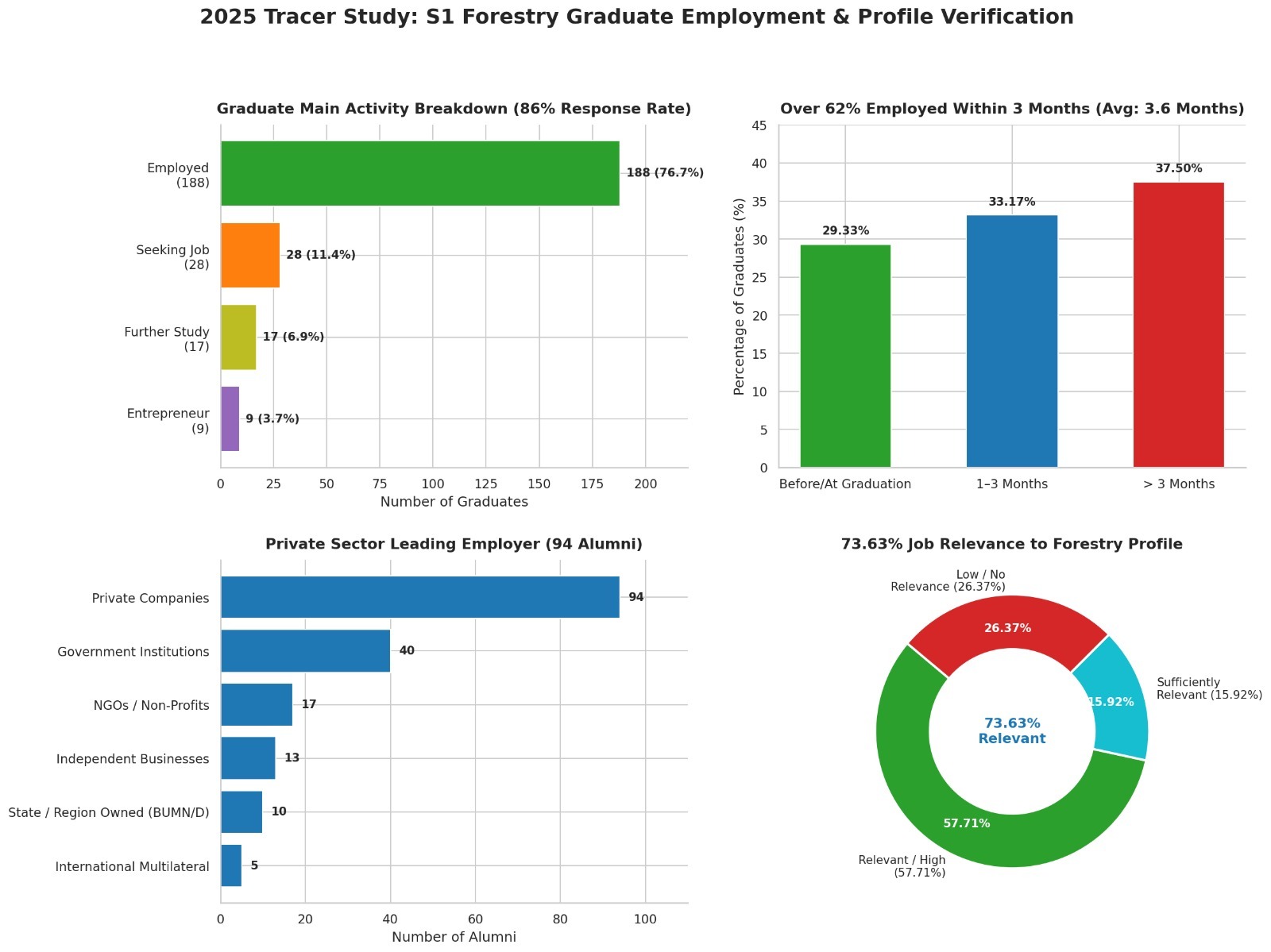
The 2025 Tracer Study of S1 Forestry graduates shows a strong employment outcome, with an overall response rate of 86%. Of the respondents, 188 graduates (76.7%) were employed, while 28 graduates (11.4%) were seeking employment, 17 (6.9%) pursued further studies, and 9 (3.7%) became entrepreneurs. These findings indicate that employment is the predominant post-graduation pathway for S1 Forestry graduates.
Regarding the transition from graduation to employment, more than 62% of graduates obtained employment within three months. Specifically, 29.33% were employed before or at graduation, while 33.17% secured employment within 1–3 months. The average waiting period for employment was 3.6 months, indicating a relatively efficient transition from higher education to the labor market.
In terms of employment sectors, private companies were the leading employers, employing 94 alumni, followed by government institutions (40), NGOs/non-profit organizations (17), independent businesses (13), state/regional-owned enterprises (10), and international/multinational organizations (5). This distribution demonstrates that Forestry graduates have access to diverse employment sectors, with the private sector providing the largest share of employment opportunities.
The tracer study also indicates a high level of alignment between graduates’ employment and their Forestry background. Overall, 73.63% of alumni reported that their jobs were relevant to their Forestry profile. This result suggests that the majority of graduates are able to apply their Forestry-related knowledge and competencies in their professional careers.